On October 13, 2025, I had the privilege of meeting this year’s Nobel laureate in Economics, renowned economic historian Joel Mokyr in person at Northwestern. I even got a chance talking to him and took pictures! During this one-hour press conference, he stood poised between history and reality, posing sobering and profound questions with calm and clarity.
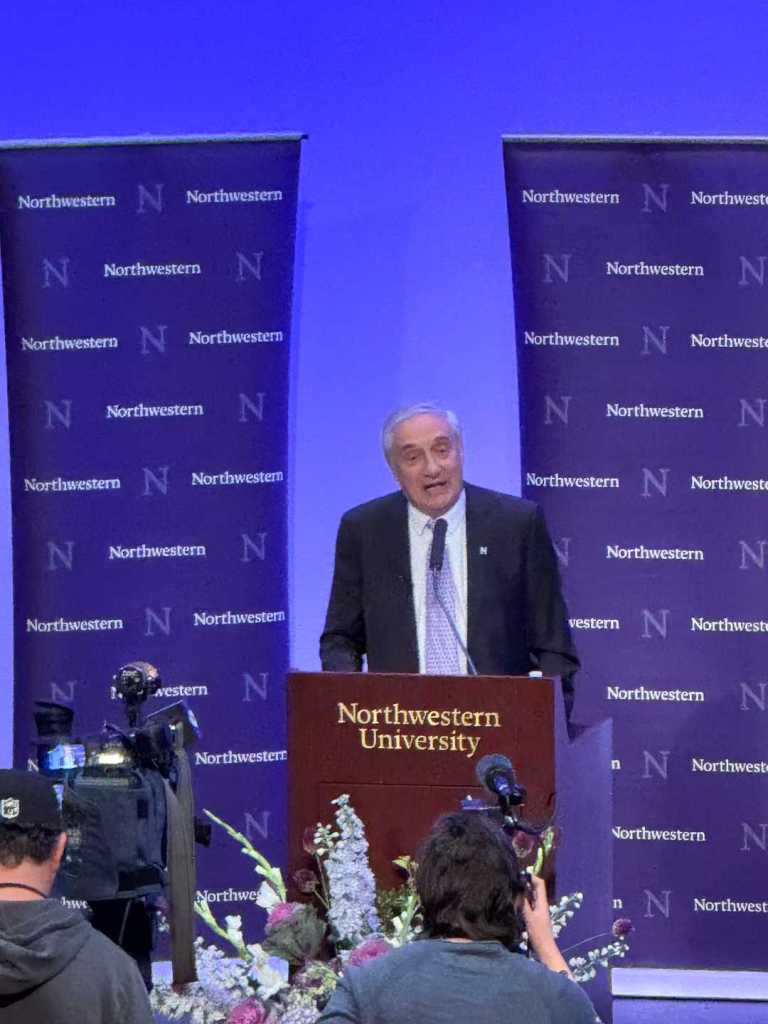
Professor Mokyr’s recognition means a lot to me, my fellow history students& researchers, and all history enthusiasts. As a former history student, I rarely hear our voices were articulated and respected so clearly in mainstream society. He said, “I had tears in my eyes. This was us. Economic historians be recognized.” Although I didn’t really focus on economic history as my main focus when studying history, I understood the weight of his words. It felt as though history, as an academic discipline, had finally received a “Yes!” in this fast-paced, STEM-dominated society. This recognition from The Royal Swedish Academy of Sciences was a tribute to memory and the past. It was also a comfort to those of us immersed ourselves in historical archives, engaging in dialogue with time and the past. I almost cried.
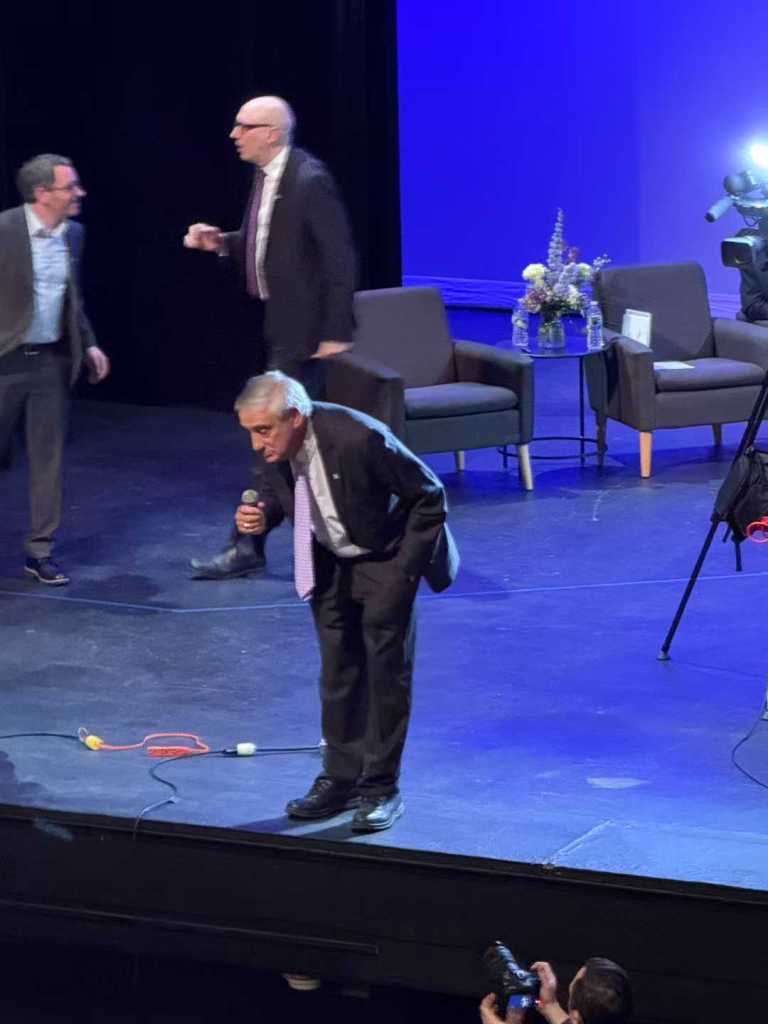
His presentation and his answer during the Q&A session inevitably circled back to his research focus: how technology and economics mutually shape each other. What impressed me very deeply during his presentation was, he said if he could choose a specific year to time travel, he would go back to 1925. For that was an era before all contemporary inventions had emerged. It was also the moment when it was still a lot of possibility for us human beings. Interestingly, the ultimate conclusion offered to society by this leading authority on history of technology and economics is a call to return to authenticity. It reflects a hidden problem about the modern world: Have we been over-reliant on new technologies that seem like magic, which we forget to consider the root of social cause beneath them? Technology is not the source of these miracles human created; it is merely the result. The true miracle lies in when human society is willing to break old orders and embrace uncertainty.
Another point professor Mokyr emphasized repeatedly in this press conference is: The most crucial factor for a society to progress is maintaining openness to new ideas and allowing change to occur. I can’t agree with this no more. This is the conclusion history has presented time and again through countless texts and events. From the Industrial Revolution to the Enlightenment, from the Cold War to globalization, it was almost impossible that these turning points has ever been driven by technology itself. What propels human society forward are shifts in social structures, the repeated reshaping of institutions, and most importantly, the will of the people. Even the most advanced technology, when forced on a society that resists change, is just a piece of stones. Only when a society is willing to listen and embrace uncertainty can it find real hope in technology.
To see why this openness matters, we need to think historically. Because history shows how human choose to change. History is not just a museum-bound discipline as we imagine. It is the deepest thread through which we understand the present, a capacity for reflection co-constructed with the past. We remember not only for the sake of memory, but to discern where the path we walk originates and where it leads.

History is not only for remembrance, but also for engaging in contemporary dialogues. Like economists, we contribute diverse perspectives toward understanding how human society can become better. We do not predict the future, but we use the past to remind people: choices always have paths, and understanding history is an indispensable step toward the future. We are not opponents of technology, but its deeper observers.
This is the significance of history in a society seems values speed and results. It is not to prove we once lived, but to help us live wisely.










 Between Lines/行间